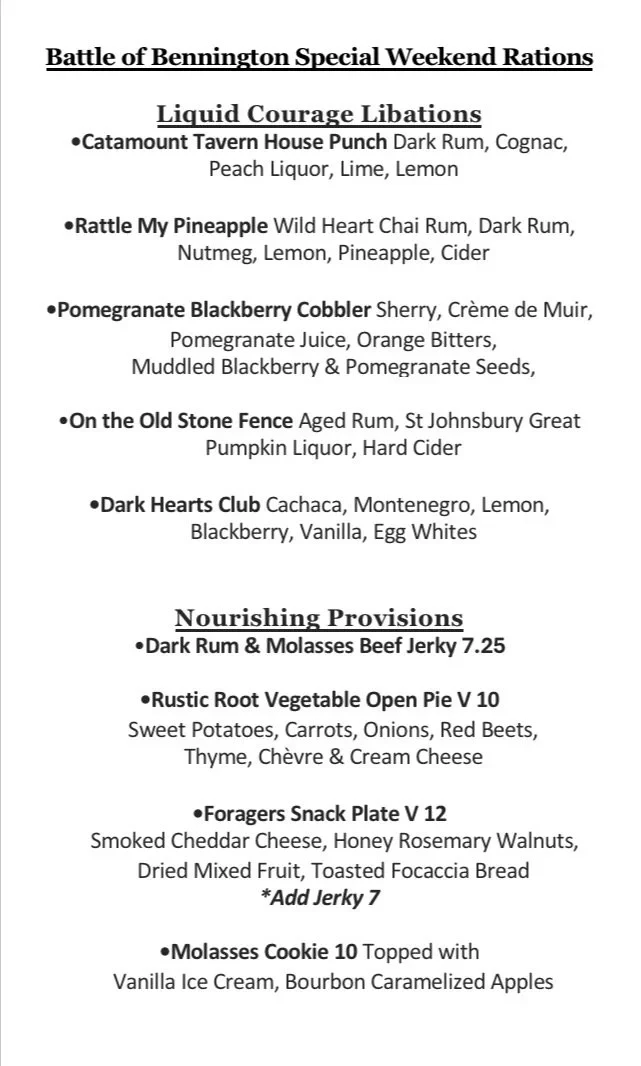
Topped with Vanilla Ice Cream, Bourbon Caramelized Apples
Historical facts
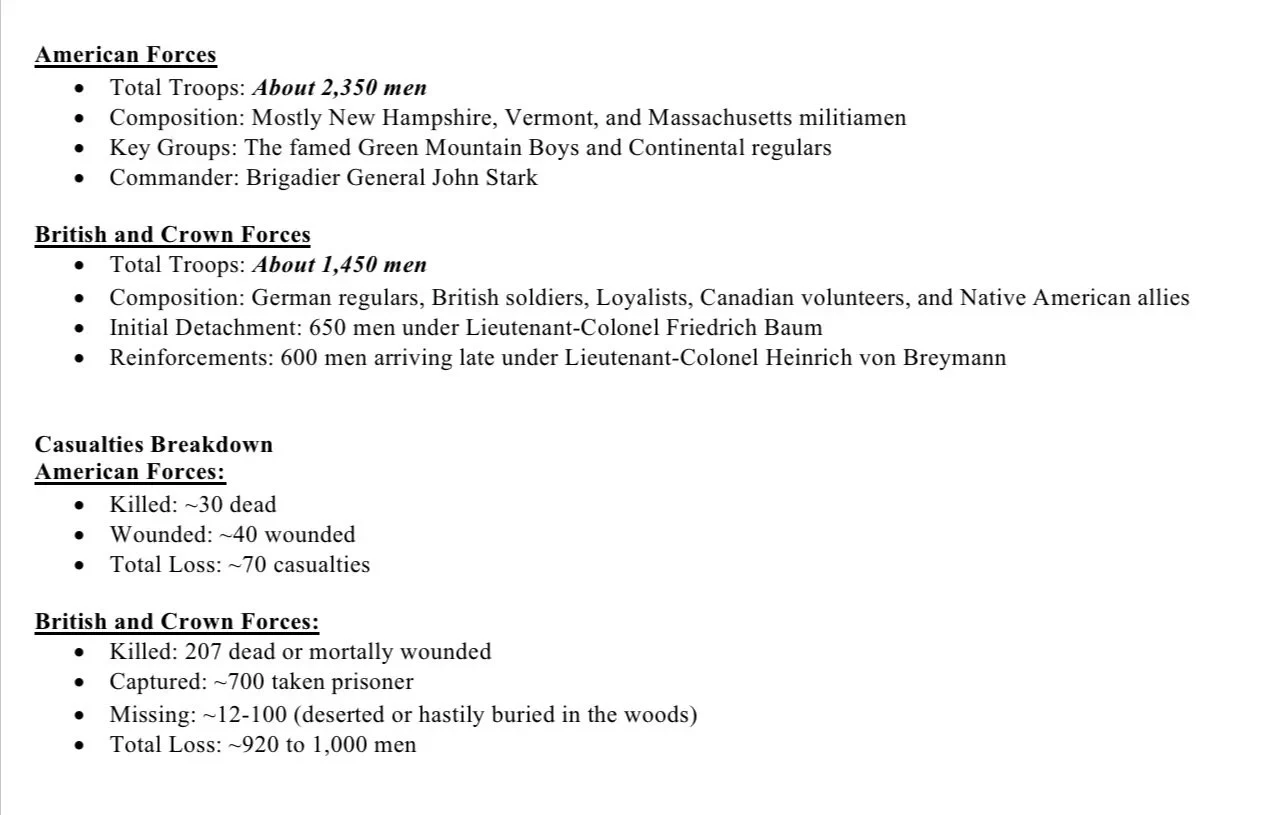
The Battle of Bennington was fought August 16, 1777.
In 1777, about 15% of Bennington’s population were Loyalists.
The Green Mountain Boys were initially an unpaid militia who acted as land protecting settlers. Ethan Allen and Seth Warner petitioned the Continental Congress in June of 1775 to officially authorize the group. They then became a regiment of the Continental Army on July 4th, 1775.
Once the Green Mountain Boys started getting paid, privates earned $6.67 per month, captains received $20 per month, and colonels received $50 per month. (In today’s money that’s about $289.08 a month for privates, $870.45 a month for captains, and $2,168.52 a month for colonels.)
While they had their formal uniforms, The Green Mountain Boys mostly wore everyday civilian clothes and hunting gear in combat. They often swapped their tri-cornered hats for hunting caps with an evergreen sprig.
The Green Mountain Boys fought in three major Revolutionary War battles: the Capture of Fort Ticonderoga in 1775, the Battle of Hubbardton in 1777, and the Battle of Bennington in 1777.
They relied on their intimate knowledge of the terrain to stage surprise attacks and swift defense.
New York (Crown supported) versus New Hampshire (Colonist led): The Green Mountain Boys fought pre-war skirmishes against New York authorities by driving off surveyors, burning rival’s buildings, and using birch-rod beatings to defend New Hampshire land titles. New York claimed jurisdiction over the region (the New Hampshire Grants), attempting to evict settlers who held titles issued by New Hampshire.